
Is AOD9604 a full growth hormone?
No. It is a short synthetic fragment corresponding to residues 176–191 of human growth hormone.
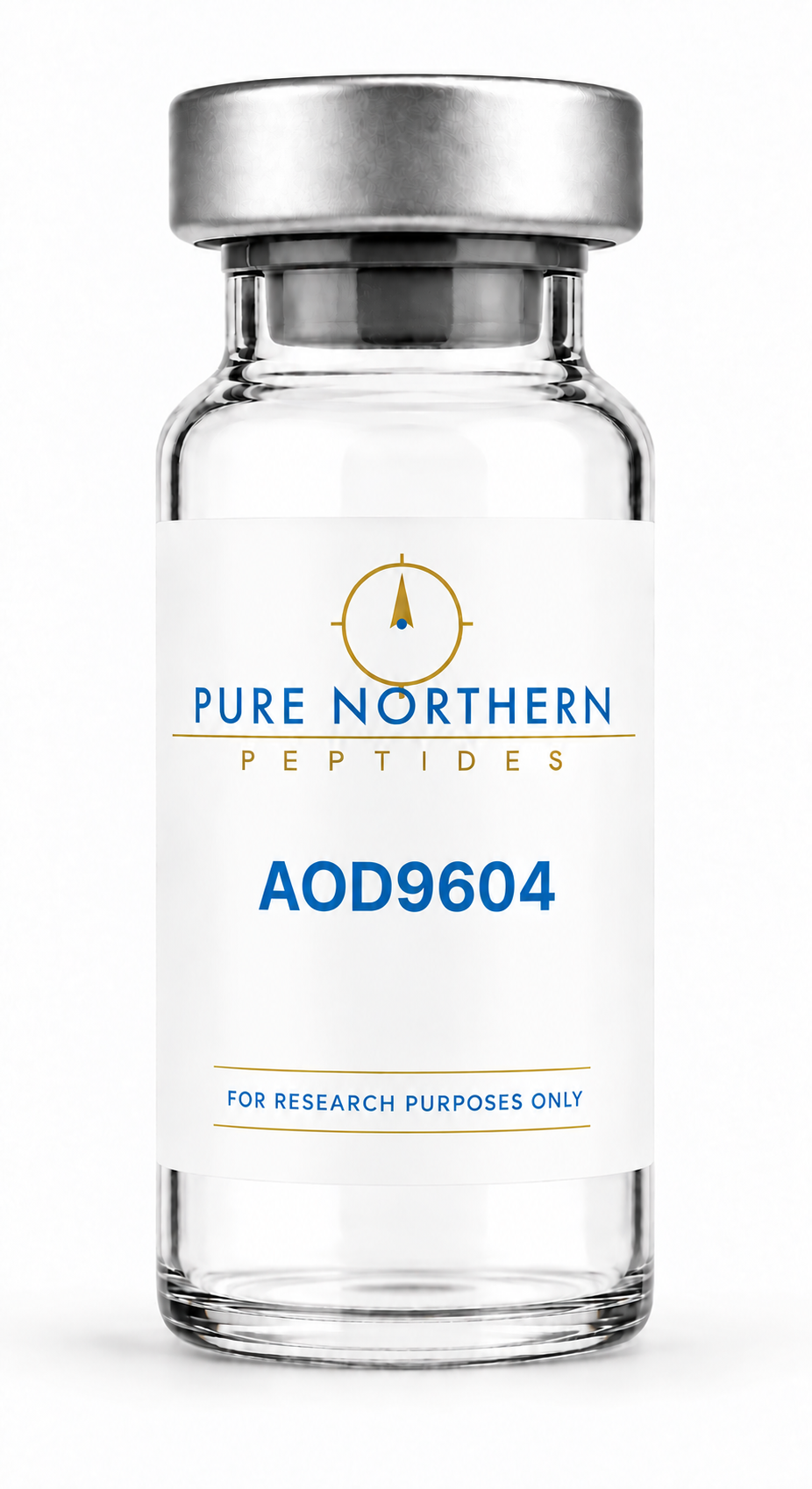 Research material
A synthetic 16-amino-acid fragment of human growth hormone. Available Commerce information controls actual product attributes and availability.
Research material
AOD9604 is a synthetic peptide fragment corresponding to amino acids 176–191 of human growth hormone. It is commonly discussed as a research tool for examining biological activities attributed to the C-terminal region of growth hormone without reproducing the full hormone sequence. In experimental settings, the fragment supports questions about adipocyte biology, lipid handling, and structure–activity relationships among growth-hormone-derived peptides. Its short sequence and fragment status distinguish it from intact growth hormone and from growth-hormone-releasing peptides. AOD9604 research material is intended only for qualified laboratory investigation, not for personal use.
Selected size
Live CAD price
$69.99
Selected size
5 mgCurrently sold out — available for pre-order
Pre-orders are accepted. Shipment will occur when stock is replenished.
Quantity
For research purposes only. Not for human or veterinary use.
Free shipping on orders over $250 CAD
Multi-unit savings: 3 units — 10% off · 5 units — 15% off · 10 units — 20% off. Promotional savings are subject to confirmation at checkout.
A synthetic 16-amino-acid fragment of human growth hormone. Available Commerce information controls actual product attributes and availability.
Materials are intended strictly for laboratory and analytical research.
Contact research supportPreclinical literature has explored whether AOD9604 influences lipolytic and lipogenic signalling in adipose-related models. Proposed mechanisms have included effects associated with beta-adrenergic pathways and hormone-sensitive lipase, but pathway attribution remains model-dependent and should not be generalized beyond the experimental evidence. Researchers may use the fragment to compare C-terminal growth-hormone sequence activity with full-length hormone biology, evaluate concentration–response relationships in cells, or investigate peptide stability and receptor-independent hypotheses. These are research questions, not evidence of a promised physiological effect.
Much discussion of AOD9604 is preclinical or mechanistic. Findings should be interpreted according to the specific model, endpoint, and controls used.
No. It is a short synthetic fragment corresponding to residues 176–191 of human growth hormone.
It is used in research examining growth-hormone-fragment biology and adipocyte-associated signalling.
Several mechanisms are proposed from experimental work, but interpretation remains dependent on the study model.